 Costa Tiling


A pool on the Costa del Sol works hard: months of strong sun, treated water, salt in the air and, in many villas, years of use before anyone looks closely at the tiles. Sooner or later the lining needs attention, and the question is usually the same: like for like, or something different?
Signs your pool needs re-tiling
A few loose tiles can often be repaired. But when several of these appear together, patching usually just postpones the problem:
- Tiles coming away, or sounding hollow when tapped, especially along the waterline and on the steps.
- Grout that is missing, soft or eroded, leaving gaps you can feel with a fingernail.
- Cracked tiles, or cracks in the render behind them.
- Water loss beyond normal evaporation, once the pipes and fittings have been ruled out.
- Sharp, chipped edges, a hazard for bare feet.
- Loose or cracked coping, letting water get in behind the lining.
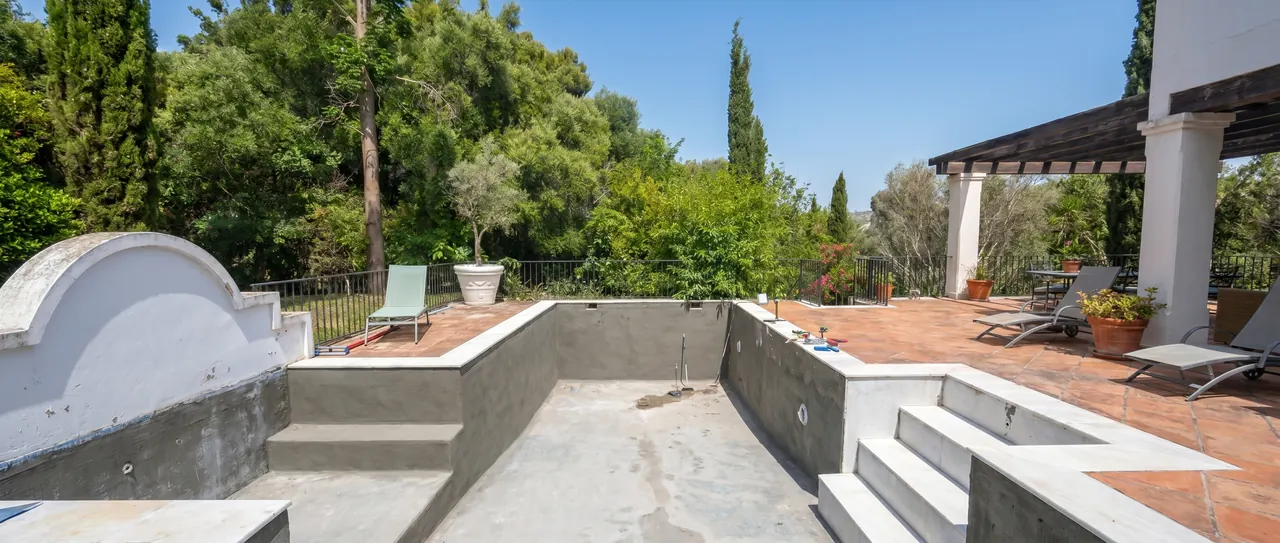
The garden pool in Sotogrande above was re-tiled in Aegean glass mosaic in 22 days, a useful benchmark if you are planning around the summer.
Glass mosaic or porcelain?
Glass mosaic
Glass mosaic has been the pool standard for decades. Glass does not absorb water and is not affected by chlorine or salt chlorination. In most glass mosaics the colour is in the glass itself rather than a surface coat, so it does not fade in the sun. The small pieces, supplied on sheets, wrap around curves, steps, benches and rounded ends without awkward cuts.
Under water it gives that familiar depth and shimmer, and blends of two or three shades read as moving light rather than flat colour. The trade-off is the number of joints, so grout choice and laying quality make all the difference.
Porcelain
Porcelain gives a more contemporary result: larger pieces, fewer joints, and finishes that imitate stone or concrete or simply sit in one clean colour. It is hard-wearing and absorbs very little water. In a rectangular pool that continues the look of a porcelain terrace, it can be striking.
It is less forgiving, though. Curves and rounded steps need many cuts, the walls must be flat and true for large tiles to sit right, and the tile must be specified by its manufacturer as suitable for pool immersion. Steps and shallow areas need a slip-resistant finish.
Colour affects the water as much as the tile. Light blues and sandy tones give the bright turquoise most people picture; greys and dark tones give deeper, lake-like water.
| Glass mosaic | Porcelain | |
|---|---|---|
| Water absorption | Virtually none | Very low |
| Chlorine and salt | Highly resistant | Resistant, if rated for pools |
| Curves, steps, rounded ends | Wraps around them easily | Many cuts; best for straight sides |
| Look | Classic shimmer, blends of shades | Calm and architectural; stone or concrete looks |
| Joints | Many; grout quality is critical | Few; less grout to maintain |
| Laying | Skilled work; must sit perfectly flat | Needs very flat walls and precise setting out |

Free site visit along the Costa del Sol, and a reply within 24 hours.
What goes behind the tile
The tile is only the last of several layers, and each one needs doing properly:
- Repair the shell and render. Hollow render is removed, cracks are assessed and repaired, and the surface is brought back to sound and flat.
- Waterproof. A flexible cementitious membrane rated for permanent immersion goes over the whole surface, reinforced at corners and around every fitting: skimmers, lights, inlets and the main drain.
- Use the right adhesive. Pools call for an improved, deformable cementitious adhesive (classed C2 S1 or better) suitable for immersion. With glass mosaic it should be white, because grey adhesive can show through the glass and dull the colour.
- Choose the grout for the water. Epoxy grout is the strongest option: it barely absorbs water, resists chlorine and cleaning products, and does not wash out the way cement grout can when water chemistry drifts. It is slower to apply, especially on mosaic. High-performance cementitious grout is an option but needs more upkeep.
- Respect curing times. Membrane, adhesive and grout must cure fully before the pool is filled. Filling too early is one of the commonest causes of problems later.
Coping and the terrace around the pool
The coping and terrace are what you stand on, sit on and look at every day.
- Slip resistance. People walk barefoot on wet surfaces here. Look for Class 3, the highest on the Spanish scale, or R11 and above on the German ramp test; barefoot ratings (A, B, C, with C the most demanding) are also worth checking. Each comes from a different test, so compare like with like.
- Heat. In July and August, dark stone and dark porcelain can become too hot to walk on. Light, matt finishes stay noticeably cooler underfoot.
- Detailing. Rounded coping edges are kinder to elbows and feet. The terrace should fall away from the pool so rain and dirt do not wash in, and large paved areas need movement joints.
Natural stone such as limestone or travertine looks beautiful around a pool, but it needs sealing and resealing, and some stones suffer from splashes of chlorinated or salt water. Outdoor stone-look porcelain avoids most of that upkeep. Our floor and wall tiling page shows the options.
When to do it on the coast
The best window on the Costa del Sol runs from autumn to spring. The pool is out of use, mild temperatures suit adhesives and grouts (strong heat makes them set too fast), and there is time for everything to cure and for the water to be balanced before summer.
Spring books up quickly, so if you want it done before summer, plan it in autumn or winter. Ask in advance where the old water can be discharged, as towns and communities may have their own rules, and avoid leaving an empty pool in strong sun for longer than necessary.
Looking after the new lining
- Keep the water balanced. Water with low pH or low alkalinity attacks grout; scaling water leaves white deposits. Test regularly.
- Brush the waterline. The coast's hard water leaves limescale there; regular soft brushing prevents build-up.
- Go easy on acid. Avoid strong acid washes unless your installer has confirmed the grout can take them.
- Keep spares. Store a few sheets or tiles from the same batch for future repairs.
- Check once a year. Before summer, look over the coping, waterline and steps, and fix any loose piece early.

You can see more of our work on the pools page and in our projects. If your pool is showing its age, ask for a free site visit. We will check the lining, the coping and the terrace, talk through glass mosaic or porcelain, and give you a fixed written quote. Book your visit, ideally before spring fills the calendar.